Popular Animals Illustration Vol 08: A Versatile Hand-Drawn Resource for Educational and Creative Projects
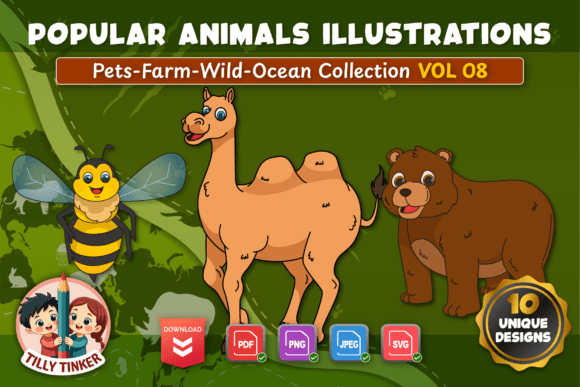
When you need animal illustrations that balance visual appeal with practical utility, the choices can feel surprisingly scattered. Some collections lean heavily into realism but lose the warmth that younger audiences respond to. Others go fully cartoonish, which can feel out of place in structured learning materials. Popular Animals Illustration Vol 08 sits in a useful middle ground. This hand-drawn collection of ten animals—camel, blue tang, bee, beaver, bear, bat, antelope, anglerfish, alpaca, and cat—uses clean outlines, soft shading, and friendly cartoon details that work across a surprising range of contexts. Understanding what this collection offers, where it fits best, and where it may fall short can help you decide whether it aligns with your particular project or audience.
What Makes This Collection Distinct
The set is built around a consistent visual language. Each illustration is hand-drawn with smooth outlines and a deliberately simplified approach to color and form. The shading is soft rather than dramatic, and the animal features are expressive enough to feel approachable without becoming exaggerated. The result is a style that reads as polished but not overproduced. The blue tang, for example, has enough anatomical detail to be recognizable as a specific species, yet the rounded shapes and gentle highlights keep it from feeling clinical. Similarly, the anglerfish includes the characteristic lure and jaw structure, but the overall treatment makes it suitable for early education rather than a deep-sea documentary.
The collection includes ten animals that span desert, forest, freshwater, marine, and farm environments. This range means you are not locked into a single biome or theme. The camel and alpaca bring arid and high-altitude contexts; the beaver, bear, and bat cover woodland and cave habitats; the blue tang and anglerfish offer ocean representation; the antelope suggests grassland or savanna settings; and the bee and cat fit both nature and domestic themes. This breadth is one of the collection's strongest practical advantages.
Comparing Style and Function
If you have worked with other animal illustration sets, you may have noticed that many fall into one of two categories. The first is highly detailed realism, which works well for biology textbooks or reference materials but can feel too dense for young children or decorative use. The second is highly simplified flat vector art, which is easy to scale and edit but sometimes lacks the character that holds a child's attention. Popular Animals Colorful Illustrations – Vol 08 occupies a space between these two approaches. The illustrations are detailed enough to support vocabulary learning and species identification, yet simple enough to function well at small sizes on flashcards or as large poster elements.
The hand-drawn quality also matters in practice. Many vector-only collections look identical across every asset, which can make a set feel uniform but also a bit lifeless. The hand-drawn lines in this collection introduce subtle variation—slightly uneven strokes, naturally curved contours—that gives each animal a distinct personality. For nursery decor or classroom materials, that small difference can make the illustrations feel more engaging over repeated use. For professional design projects, the consistency of the style still allows the set to be used as a coherent suite.
Strengths and Practical Tradeoffs
The collection's strongest advantage is its versatility across formats and age groups. Each illustration is provided at 8.5 × 8.5 inches, 300 DPI, in PDF, PNG, JPG, and editable SVG formats, with transparent backgrounds in both PNG and SVG. This means you can drop the camel into a desert-themed worksheet, resize the blue tang for a sticker sheet, or place the bear onto a nursery poster without spending time cutting out backgrounds or rebuilding the artwork. The editable SVG format is particularly useful if you need to adjust colors, combine animals, or scale them beyond the original square format for a specific layout.
For educational use, the simplified but accurate representations work well for building vocabulary cards. A child learning the difference between an antelope and an alpaca will see distinct body shapes and proportions, not just generic quadruped forms. The friendly styling also helps reduce the intimidation factor for animals like bats or anglerfish that can seem scary in realistic depictions. The bat in this collection has a rounded face and soft wing curves that make it approachable for preschool and early elementary use.
There are, however, tradeoffs to consider. The square format (8.5 × 8.5 inches) is convenient for many uses, but if you need landscape or portrait compositions, you will need to edit the SVG files or work within the square crop. The hand-drawn style, while charming, may not suit every brand or project. If your design direction calls for extremely clean, geometric, or flat-design aesthetics, the organic line quality of these illustrations could feel out of place. Similarly, the soft shading, while effective for print and digital display, may not reproduce as cleanly on very low-resolution screens or in extremely small icon sizes where simpler flat vectors would hold up better.
Best-Fit Situations and Use Cases
One of the most natural applications for Popular Animals Illustration Vol 08 is in early childhood and elementary education materials. Teachers and homeschool parents can use the images for vocabulary building, animal classification activities, or story prompts. The bee and cat are familiar enough for very young children, while the antelope and anglerfish introduce less common animals in a friendly way. The transparent PNG and SVG formats make it easy to layer the animals onto worksheets, scavenger hunt sheets, or habitat sorting activities.
For nursery decor, the soft shading and gentle outlines contribute to a calm visual environment. The camel or alpaca in a desert-themed room, or the blue tang in an ocean nursery, work as standalone prints or as part of a larger animal wall gallery. The 8.5 × 8.5 inch square size is close to standard print sizes, so framing or mounting is straightforward. The editable SVG files also let you resize the illustrations for custom wall decals or fabric transfers.
Flashcards are another strong use case. The consistent style across all ten animals means that a set of cards will feel unified. The square format aligns well with common card sizes, and the high resolution ensures clear printing even at smaller dimensions. For teachers creating vocabulary sets for English language learners or bilingual classrooms, the simple but distinct visuals support word-picture association without distracting background elements.
KDP interiors and activity books also benefit from this collection. The hand-drawn quality works well for coloring pages, especially if you convert the color illustrations to line art. The animals are detailed enough to provide satisfying coloring areas but not so complex that young children become frustrated. The set's variety allows you to create themed activity books—desert animals, ocean animals, forest animals—from a single purchase.
When You May Need a Different Option
While Popular Animals Colorful Illustrations – Vol 08 covers a wide range of scenarios, it is not a universal solution. If your project requires photographic realism—for example, a middle school biology text or a wildlife conservation infographic—these hand-drawn illustrations will not convey the texture and detail that photographs provide. Similarly, if you need a complete set of farm animals, this collection includes only the alpaca and cat in that category; you would need supplementary resources for horses, pigs, chickens, and cows.
For projects that require extreme minimalism or strict brand consistency with specific color palettes, the hand-drawn line variation and soft shading may introduce too much organic character. A flat vector style with uniform strokes and fill colors might be more repeatable across hundreds of assets. Likewise, if you need hundreds of animal illustrations for a large curriculum, a single volume of ten animals may serve as a starting point rather than a complete solution. You might consider combining this set with other volumes or supplementary collections to build a broader library.
Another factor is the square format. If your materials consistently use 8.5 × 11 inch or A4 portrait pages, the square illustrations may require some layout adjustment. The transparent backgrounds help with placement, but you may need to add background elements or borders to fill the page area effectively. This is manageable with the SVG files but adds time to your workflow.
Decision Factors to Consider
Before choosing this collection, think about the age range of your audience, the consistency of your visual style across materials, and the technical requirements of your output format. For preschool through early elementary audiences, the friendly, clean style is a strong fit. For older students or professional reference materials, you may want to supplement with more detailed or realistic assets.
Consider also how you will use the files. If you plan to edit and customize—changing colors, adding text, combining animals—the SVG format gives you flexibility that a strictly PNG-based collection would lack. If you only need ready-to-print images, the included JPG and PDF files require no additional software. The transparent background support is a genuine time-saver for anyone who has struggled with removing white backgrounds from clip art collections.
The range of animals in this volume is diverse but not exhaustive. If your curriculum or project relies heavily on a particular habitat or group (for example, only marine life or only African savanna animals), you may find that only a subset of the illustrations are useful. In that case, a more targeted collection might offer better value. But if you appreciate variety and want a single set that can serve multiple thematic units, the mix here is thoughtfully chosen.
Practical Examples of Use
A preschool teacher creating a "desert and ocean" theme unit could use the camel and blue tang as centerpiece visuals, supported by the bee and bear for related storytelling about environments. The square format works well for a bulletin board display where each animal is printed, laminated, and arranged around a world map. The homeschool parent building a letter-of-the-week curriculum can assign this bee for B, this bear for B, and this bat for B—giving multiple options for the same letter to create variety across weeks.
A designer working on a children's app might use the SVG files to integrate interactive elements. The anglerfish could become a tap-target with its lure glowing, while the alpaca could be part of a farm puzzle. The high resolution ensures the illustrations look crisp on Retina screens, and the editable source files allow for color adjustments to match the app's palette. A creator publishing a KDP animal coloring book could convert the color illustrations to grayscale line art, then organize them by difficulty: the cat and bee for simpler pages, the anteater (or rather, antelope) and anglerfish for more detailed ones.
Making an Informed Choice
Popular Animals Illustration Vol 08 is best understood as a middle-ground resource. It is not the most detailed scientific reference, nor is it the simplest flat vector set. Its value lies in the balance it strikes: hand-drawn warmth with clean digital execution, enough detail for education but enough simplicity for decor and design. If you need animal illustrations that children will find inviting, that teachers can adapt across multiple subjects, and that designers can edit and repurpose, this collection offers a practical foundation. If your needs are more specialized—whether toward extreme realism or extreme minimalism—you may want to look for a collection that aligns more narrowly with that direction. For anyone working across preschool and early elementary materials, nursery design, flashcards, activity books, or classroom decor, this volume delivers a coherent, immediately usable set of animal illustrations that require minimal preparation to put to work.